Do Furniture Stores Take Away Old Furniture in Ireland?
A comprehensive analysis of retailer obligations, legislative enforcement, and professional disposal frameworks within the Irish circular economy.
Book Furniture Removal1. The Legislative Foundation of Waste Management in Ireland
The transition of the Republic of Ireland towards a circular economy represents a fundamental shift in how domestic assets are managed, particularly regarding bulky furniture items. For decades, the linear model of consumption dominated the Irish market, where furniture was purchased, used, and ultimately discarded into landfill sites. However, contemporary environmental pressures and European Union directives have necessitated a more sophisticated approach.
As the Irish government works towards reducing the municipal landfill rate to ten percent or less by 2035, the role of furniture disposal becomes a critical focal point. This progress is evident in the historical data which shows that the landfill rate for municipal waste in Ireland dropped from sixty two percent in 2008 to just fourteen percent in 2018. Despite this success, the logistical reality for an individual attempting to remove a three seater sofa or a king size mattress from a terraced house in Dublin or a rural farmhouse in Galway remains fraught with challenges.
The cornerstone of all waste related activities in the state is the Waste Management Act 1996. This substantial piece of legislation was designed to provide a comprehensive regulatory framework for the application of higher environmental standards in response to both national requirements and European Union law. The Act defines waste as anything which a holder discards, intends to discard, or is required to discard.
Within this legal framework, the concept of discard has a broad scope, ensuring that materials destined for recovery or recycling are still treated with the same rigour as those destined for disposal.
The General Duty of Care
One of the most critical aspects of the 1996 Act for the average citizen is the general duty of care. This legal obligation dictates that a holder of waste must not hold, transport, recover, or dispose of waste in a manner that causes or is likely to cause environmental pollution. Furthermore, the law prohibits any person from transferring control of waste to a person who is not an authorised waste collector.
Legal Warning for Householders:
A homeowner who hires an unlicensed individual to remove an old wardrobe is effectively breaking the law. If that wardrobe is subsequently found in a roadside ditch, the original owner remains legally responsible and can be prosecuted for the offence. Enforcement is shared between local authorities and the Environmental Protection Agency, with the latter focusing on larger scale issues and the former managing domestic and local compliance.
2. Penalties for Non Compliance and Fly Tipping
The penalties for violating waste management laws in Ireland are among the most stringent in Europe, reflecting the high cost of cleaning up illegal dumping sites and the damage caused to the environment. Fly tipping is the term commonly used to describe the illegal disposal of household or commercial waste on land that does not have a licence to accept it. This includes dumping sofas in bogs, leaving mattresses in laneways, or placing household bags in public litter bins.
| Offence Category | Summary Conviction | Indictment Conviction |
|---|---|---|
| Littering or Small Scale Dumping | Fine up to €4,000 | Fine up to €130,000 |
| Serious Unauthorised Disposal | Fine up to €5,000 and/or 12 months prison | Fine up to €15 Million and/or 10 years prison |
| Continued Offences | €600 per day | €10,000 per day |
| Littering On The Spot Fine | €150 | Not applicable |
The economic burden of these illegal activities is significant. In recent years, local authorities in Ireland have spent millions of Euro annually on the remediation of illegal dumping sites. Beyond the financial cost, fly tipping poses a threat to wildlife, contaminates groundwater with toxic materials, and increases fire risks in rural areas. To combat this, many local authorities have turned to technology, including the use of solar powered and infrared closed circuit television cameras at known dumping hotspots. Such measures have led to a noticeable reduction in incidents in certain counties, with Cork reporting a thirty percent decrease in some areas following the installation of monitoring equipment.

Most Irish furniture retailers only collect your old item if you buy a matching replacement — and charge a removal fee to do it
3. Retailer Take Back Policies: A Detailed Examination
For many householders, the most logical time to dispose of old furniture is when a new replacement is being delivered. This has led to the expectation that furniture stores should offer a removal service. While many major retailers in Ireland do provide such options, they are almost always governed by strict terms and conditions that often surprise the consumer at the point of delivery. These schemes are generally designed to facilitate the sale of new products rather than acting as a general waste disposal service.
The Like For Like Requirement
The primary restriction across almost all retailer schemes is the like for like condition. This means that a store will only collect an old item if it is replaced by a similar new item purchased from that store. If a customer buys a new bed, the store might take the old bed, but they will not take an old sofa at the same time. This ensures that retailers are not functioning as general junk removal companies and helps them manage the limited space on their delivery vehicles.
Retailer Policy Comparison
Different stores have adopted varying strategies for furniture removal, reflecting their different market positions and logistical capabilities. The following table outlines the current costs and conditions for some of the most prominent retailers operating in the Irish market.
| Retailer | Service | Cost | Conditions |
|---|---|---|---|
| IKEA Ireland | Mattress Removal | €40 per item | Must be bagged, dry, and near front door |
| Harvey Norman | Sofa Removal and Recycle | €35 per seat | Like for like with delivery purchase |
| Caseys Furniture | Bed and Sofa Recycling | €50 to €150 | Bed frames must be disassembled |
| Michael Murphy | Bed and Mattress Removal | €79 for the set | Nationwide delivery and collection available |
| EZ Living | Mattress Disposal | €39 to €45 | Mattress only; no sofa disposal offered |
| Bargaintown | Multiple Item Removal | €19 to €70 | Extensive menu based on item size and type |
IKEA Ireland and the Circular Economy
IKEA has attempted to position itself as a leader in sustainable furniture management through several initiatives beyond simple disposal. Their mattress removal service is priced at a flat rate of forty Euro, but it comes with significant preparation requirements. The customer must visit a store to book the service as it is not currently available for online orders. Upon booking, IKEA provides a specific bag, and the customer must ensure the mattress is dry, bagged, and positioned near the front door. Failure to meet these criteria results in a failed collection and a requirement to rebook and pay the fee again.
Beyond disposal, IKEA operates a Buyback and Resell service that allows customers to return used IKEA furniture in good condition in exchange for store credit. As new pieces receive forty five percent of the original price, while well used items receive twenty five percent. A major constraint is that items must be returned to the store fully assembled, creating a significant logistical barrier for most people.
Harvey Norman and Sectional Pricing Models
Harvey Norman utilizes a different pricing model for its furniture removal service, specifically for sofas. Rather than charging per unit, they charge thirty five Euro per seat. This nuanced approach means that while a simple armchair costs thirty five Euro to remove, a large corner sofa could easily cost over one hundred and forty Euro. This service is strictly tied to a new purchase and is executed at the time of delivery. Like many other retailers, Harvey Norman also complies with Waste Electrical and Electronic Equipment regulations, providing free take back for old appliances on a one for one basis when a customer buys a new kitchen appliance.
Caseys Furniture and the Requirement for Disassembly
Caseys Furniture offers a recycling service that covers mattresses, bed frames, and sofas. Their pricing for a three seater sofa is among the highest in the market at one hundred and fifty Euro. A specific and mandatory condition for Caseys is that all bed frames must be disassembled by the customer before the delivery team arrives. This highlights a common issue with retailer schemes: the staff are typically delivery drivers rather than professional movers or labourers, and they are not insured or time allocated to perform dismantling tasks.
EZ Living and Limited Service Scope
The policy at EZ Living Furniture demonstrates the inconsistency within the retail sector. While they offer a mattress disposal service for between thirty nine and forty five Euro depending on size, they explicitly state that they do not offer sofa removal services. Instead, they advise customers to contact their local council or a private waste disposal company. This gap in service can be frustrating for a customer who is upgrading their entire living room and expects the retailer to handle the old items.
Key Retailer Service Limitations:
- Like-for-like only: You must buy a matching new item to trigger removal.
- Customer preparation required: Bed frames disassembled, mattresses bagged, items at front door.
- Per-seat pricing on sofas: A corner sofa at Harvey Norman can exceed €140.
- No mixed items: Buying a sofa won't get your old wardrobe taken.
4. Charitable Donations and the Safety Regulation Barrier
For many householders, the first thought when disposing of furniture is to donate it to a charity such as the Society of St Vincent de Paul or Vision Ireland. This is a commendable goal that supports the circular economy by extending the life of products. However, the charitable sector in Ireland is not a catch all solution for unwanted furniture due to strict legal and quality requirements.
The Crucial Role of Fire Safety Labels
The most significant barrier to donating upholstered furniture in Ireland is the requirement for fire safety labels. Under Irish law, it is illegal for a charity to sell upholstered furniture that does not have the original fire safety labels permanently attached. These labels prove that the materials meet specific flame retardancy standards. If these labels have been removed or lost, a charity like Vision Ireland or the St Vincent de Paul will be forced to reject the item regardless of how clean or comfortable it appears.
Quality and Hygiene Standards
Charities are also limited by their ability to store and transport bulky items. Most charities will only accept items that are in good condition, complete, and fully functional. Vision Ireland, which operates a free furniture collection service in Dublin, Meath, Kildare, and Wicklow, requires donors to send photographs of the items via email before a collection can be booked.
This vetting process ensures that the charity does not incur the cost of disposing of unsellable goods. Most charities, including the St Vincent de Paul and Vision Ireland, have a strict policy against accepting mattresses, duvets, or pillows due to hygiene regulations.
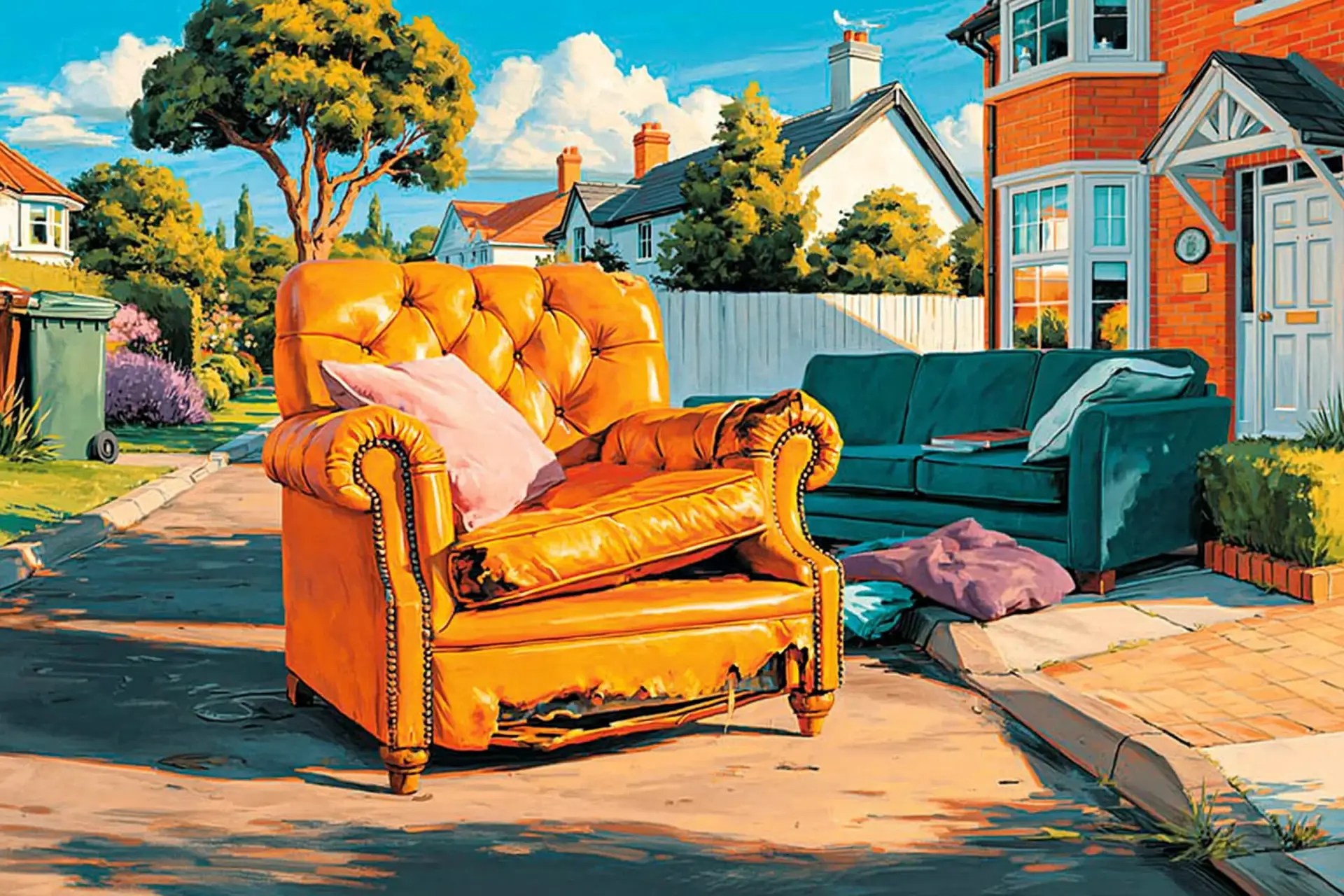
Upholstered furniture can only be donated if its fire safety label is still attached — without it, even a clean sofa will be refused
The Hidden Cost to Charities:
It is a common misconception that leaving a broken or stained sofa outside a charity shop is a helpful act. In reality, this is a form of illegal dumping. Charities often have to spend a significant portion of their raised funds on professional waste disposal services to remove items that have been left on their doorsteps. For this reason, the charitable sector is increasingly selective, focusing on items with high resale value that can directly fund their social programmes.
5. Professional Waste Collection as the Flexible Alternative
Given the limitations of retailer take back schemes and the strict requirements of charities, many Irish householders find themselves in a difficult position. They may have a sofa that is too old for charity and a retailer that refuses to take it because a new one was not purchased, or they may need a collection on a specific day that the retailer cannot accommodate. This is where professional, licensed waste collection services become essential.
The Kollect Model of Furniture Removal
Kollect has established itself as a major player in the Irish waste market by offering a service that addresses the specific pain points of traditional disposal methods. Unlike retailers, Kollect does not require a purchase of new furniture. They operate a nationwide service that can collect any piece of furniture, regardless of its condition or the presence of fire labels.
One of the primary advantages of this professional approach is the inclusion of labour. While retailers often require items to be disassembled or moved to the kerbside, Kollect provides a man and van service where two experienced professionals perform all the lifting and loading from inside the property. This is a critical service for elderly residents, people with mobility issues, or those living in apartment complexes where moving a large wardrobe down several flights of stairs is a major undertaking.
Pricing and Environmental Responsibility
Professional collection services generally price their work based on the volume of waste rather than a simple per item fee. For example, a standard truckload is often broken down into fractions, allowing for a more accurate cost for the consumer. Kollect offers furniture removal starting from seventy five Euro, with options for larger clearouts where the cost is determined by the space used in the vehicle.
As an authorised waste collector, Kollect ensures that all collected furniture is taken to a registered facility where it is assessed for recycling or landfill diversion. This is an important trust signal for consumers who want to ensure their waste is managed legally and sustainably. In the context of the Waste Management Act, using a licensed professional is the only way for a householder to fully discharge their legal duty of care.
6. Regional Variations in Disposal Infrastructure
The ease with which a householder can dispose of furniture often depends on their geographic location within Ireland. Different local authorities have developed different infrastructures for bulky waste management, ranging from high quality civic amenity sites to limited kerbside collection days.
Civic Amenity Sites in Cork and Dublin
Civic amenity sites, also known as recycling centres, are the backbone of local authority waste infrastructure. These sites allow members of the public to bring a wide range of materials for disposal or recycling for a relatively low fee.
| Location | Entry Fee | Mattress Fee | Sofa Fee |
|---|---|---|---|
| Cork County Council Sites | €4 | €10 to €20 | €15 to €30 |
| Cork City Council Site | €3 | €15 to €20 | €10 to €25 |
| Dublin City Council (Typical) | €5 | €15 to €25 | €20 to €40 |
While these sites are cost effective, they represent a significant logistical challenge for the average person. Transporting a large sofa requires a trailer or a large van, which many urban residents do not possess. Furthermore, the householder is responsible for all the lifting at both ends of the journey. For those living in rural areas, the nearest civic amenity site may be a considerable distance away, making the journey both time consuming and expensive in terms of fuel.
Local Authority Kerbside Collections
Some local authorities, particularly in major cities, offer a bulky waste collection service for a fee. Dublin City Council provides such a service for forty Euro per collection, which covers up to five individual items. While this is a very affordable option, it has several drawbacks. The collection date is determined by the council, and the resident must place the items on the public footpath themselves. This can lead to issues with pavement obstruction, and if it rains, the items can become heavy and sodden, making them much more difficult for the council crews to handle.
7. The Environmental Science of Furniture Recycling
Understanding what happens to furniture after it is collected is essential for appreciating the value of professional disposal services. Furniture is rarely a single material; it is typically a complex assembly of wood, metal, plastic, and textiles.
Wood and Metal Recovery
A significant portion of most furniture items is made of wood or metal. Bed frames, table legs, and sofa structures contain valuable timber that can be recovered. Once taken to a recycling centre, wood is often shredded and used in the production of chipboard or as carbon neutral biomass fuel for energy generation. Metals, such as the springs in mattresses and sofas, are highly recyclable. They are stripped out and sent to metal reprocessors where they are melted down to create new steel products.
The Challenge of Upholstery and Foam
The most difficult parts of a sofa to recycle are the foam and the fabric coverings. Most older furniture uses polyurethane foam which is treated with various chemical flame retardants to meet safety standards. While technology is improving, these materials are often not suitable for traditional recycling and must be processed at waste to energy facilities where they are burned under controlled conditions to generate electricity. Professional collectors like Kollect focus on landfill diversion, ensuring that even if an item cannot be fully recycled, it is used for energy recovery rather than being buried in a landfill site.
Mattress Recycling: A Specialist Field
Mattresses are among the most problematic items in the waste stream because of their bulk and their composite nature. A single mattress can contain dozens of metal springs, layers of foam, and large amounts of textile padding. Specialist mattress recycling facilities in Ireland have developed systems to mechanically strip these items, recovering up to ninety percent of the materials by weight. This is why many retailers and local authorities charge a specific fee for mattresses, reflecting the true complexity of the recycling process.

A licensed collector loads an old sofa for removal — no new purchase required, and all the lifting is included
8. The Future of Furniture Management in Ireland
As the state moves towards a more circular economy, the regulations surrounding furniture disposal are likely to become even more stringent. The Irish government has already introduced various levies to drive behavioural change, including a landfill levy of eighty five Euro per tonne and a waste recovery levy of ten Euro per tonne. These measures are intended to move material management up the waste hierarchy, away from disposal and towards recycling and reuse.
The Role of Extended Producer Responsibility
There is ongoing discussion at both the national and European levels regarding the introduction of Extended Producer Responsibility for furniture. This would be similar to the current system for electronics and batteries, where retailers and manufacturers are legally and financially responsible for the end of life management of the products they sell. Such a system would likely mandate that all furniture stores offer free or low cost take back services for any item, regardless of whether a new purchase is made. This would represent a massive shift in the Irish furniture market and would require significant investment in logistics and recycling infrastructure.
The Importance of Design for Disassembly
Another emerging trend is the concept of design for disassembly. Manufacturers are being encouraged to create furniture that can be easily taken apart into its constituent materials at the end of its life. This would simplify the recycling process and reduce the cost of professional disposal services. For the consumer, this may lead to more modular furniture that can be repaired or upgraded rather than replaced entirely.
9. Strategic Recommendations for Irish Householders
Navigating the various options for furniture disposal requires a strategic approach to ensure that the process is as efficient and cost effective as possible.
Assessing the Lifecycle of the Item
The first step for any householder should be an honest assessment of the condition of the furniture. If the item is high quality and possesses the necessary fire safety labels, the first priority should be reuse. Selling the item on a second hand marketplace or donating it to a local charity is the most sustainable option. This not only avoids waste but also provides affordable furniture for other members of the community.
Planning for the Delivery of New Goods
If a customer is purchasing new furniture, they should clarify the disposal options with the retailer at the earliest possible stage. It is important to ask for the specific costs and conditions in writing. If the retailer requires the item to be disassembled or moved to the kerbside, the householder needs to decide if they are physically able to perform these tasks. If not, the convenience of the retailer service may be negated by the additional labour required.
Utilizing Professional Services for Complex Jobs
For larger clearouts or for situations where retailer services are unavailable, a professional service is often the most logical choice. The cost of a professional collection should be weighed against the value of the labour provided and the peace of mind that comes from using a licensed collector. For those living in areas with restricted access or for those who simply do not have the time to manage the logistics, the professional man and van model is the most effective solution.
Decision Framework Snapshot:
- Good condition with fire labels: Donate to Vision Ireland or SVP.
- Buying new from a single retailer: Check like-for-like removal options at point of sale.
- Multiple items, no new purchase, or labels missing: Book a licensed professional collector.
- Single small item and access to a van: Civic amenity site is most economical.
- Fixed budget, flexible timing: Local authority bulky waste collection.
The Economic Impact of Responsible Waste Management
The management of bulky waste is not just an environmental issue but a significant economic one for the state. Illegal dumping costs the Irish taxpayer millions of Euro every year in cleanup expenses. By using legitimate disposal channels, householders contribute to a system that supports jobs in the recycling and logistics sectors and reduces the overall financial burden on local authorities. Furthermore, the recovery of materials like wood and metal reduces the need for the extraction of raw materials, which is often a costly and environmentally damaging process.
10. Final Summary of Disposal Options
The Republic of Ireland provides a range of options for the disposal of domestic furniture, each with its own set of advantages and challenges. The decision on which method to use will depend on the condition of the furniture, the budget of the householder, and their physical ability to manage the logistics of the move.
| Disposal Method | Primary Advantage | Primary Disadvantage |
|---|---|---|
| Charitable Donation | Free and socially beneficial | Very strict quality and safety criteria |
| Retailer Take Back | Convenient during new delivery | Like-for-like restrictions and high fees |
| Civic Amenity Site | Most cost effective for small items | Requires vehicle and physical labour |
| Local Council Collection | Affordable and reliable | Long lead times and kerbside requirement |
| Professional Collection | Full service with labour included | Higher upfront cost than self service |
Regardless of the method chosen, the most important factor is that the furniture is disposed of through a legal and authorised channel. The Waste Management Act 1996 places the responsibility firmly on the householder, and the consequences of getting it wrong can be severe. By choosing responsible disposal, Irish citizens are playing their part in protecting the landscape and supporting the transition to a truly circular economy.
When Retailer Options Prove Too Restrictive:
If the store options prove too complicated or restrictive, Kollect collects any old furniture from seventy five Euro. Interested parties can book online or call 01 697 2259 to arrange a nationwide collection that requires no purchase and handles all the lifting and loading.
Old Furniture to Clear?
Book a licensed collection online today. No purchase required. We handle the lifting.