
The Vacant Property Refurbishment Grant: Does It Cover Clearance, Skip Hire and Junk Removal?
Restoring abandoned homes in Ireland with financial support for site preparation and waste disposal.
Get a Clearance Quote1. What Is the Vacant Property Refurbishment Grant?
The Vacant Property Refurbishment Grant is one of the most significant housing supports in the Republic of Ireland, funded by the Department of Housing, Local Government and Heritage through the Croí Cónaithe Fund. It launched in July 2022 with a focus on regional towns and villages, and was later widened to cover every city and rural area in the country. Its purpose is direct: to tackle urban decay, slow rural depopulation, and bring long-empty buildings back into use as homes.
The money is real and substantial, but it arrives as a reimbursement rather than an upfront payment. Every grant is administered directly by the local authority, the approved figure is fully inclusive of VAT, and the council only pays out once the works are finished, fully vouched, and confirmed by a professional site inspection. In practice that means the order of events matters as much as the eligibility itself, a point that returns throughout this guide.
It Is a Reimbursement, Not a Cash Advance:
The local authority pays you back only after the approved works are completed, vouched with invoices, and verified by inspection. You need to fund the project first and recover the cost afterwards, so plan your cash flow before you commit.
The scale of the scheme has grown sharply. Since 2022, 4,514 grants have been paid out nationwide, totalling almost €247 million, and more than 3,000 properties were returned to use in 2025 alone. County Cork illustrates the momentum well: its local authorities awarded over €10 million during 2025, reactivating 316 disused homes, and have completed work on 474 vacant properties since the scheme began, placing the county second nationally behind Donegal.
| Scheme Metric | Figure |
|---|---|
| Grants paid nationwide since 2022 | 4,514 |
| Total value reimbursed to applicants | ~€247 million |
| Properties returned to use in 2025 | 3,000+ |
| Properties completed in County Cork since 2022 | 474 |
| Homes reactivated in Cork during 2025 | 316 |
2. How Much Funding Is Available?
The headline figure most applicants know is the €50,000 standard grant, available where a property has stood vacant for two years or more. If the same property is also derelict, meaning it is structurally unsound and dangerous, a top-up of up to €20,000 applies, lifting the ceiling to €70,000. Because logistics and transport are far more expensive on offshore islands, populated islands carry higher limits again: up to €60,000 for a vacant home and up to €84,000 for a derelict one.
From 31 March 2026 the scheme widened beyond traditional houses to bring unused space above shops and vacant commercial buildings back into residential use. That expansion introduced three further strands: a Vacant Above the Shop Grant worth up to €135,000, a Conversion of Former Commercial or Public Use Buildings strand worth up to an additional €40,000, and an Expert Advice Grant of up to €5,000 to help owners assess structural and statutory requirements before they commit.
| Property Type or Initiative | Maximum Grant |
|---|---|
| Vacant property (empty for 2+ years) | Up to €50,000 |
| Derelict property (structurally unsound) | Up to €70,000 |
| Vacant home on a populated offshore island | Up to €60,000 |
| Derelict home on a populated offshore island | Up to €84,000 |
| Vacant Above the Shop conversion | Up to €135,000 |
| Former commercial or public building conversion | Up to €40,000 (additional) |
| Expert Advice Grant (professional assessment) | Up to €5,000 |
3. Do I Qualify?
Eligibility is set by Citizens Information and the Department of Housing, Local Government and Heritage, and it turns on three things: the state of the building, the tax position of the applicant, and how the home will be used afterwards. The property must have been vacant for at least two years before the application date, and that vacancy has to be evidenced credibly, for example through utility bills showing zero or negligible consumption, or a sworn affidavit from a solicitor. The building must also have been constructed before 2008, an expansion from the earlier 1993 threshold that brings far more properties into scope.
You must own the property or be in the active process of buying it, with active purchase backed up by written confirmation from an estate agent or solicitor. Once the refurbishment is finished, you either live in it as your principal private residence or make it available to rent on the private market, and if you rent it the tenancy must be registered with the Residential Tenancies Board.
Eligibility Checklist:
- Vacant for at least two years, with documented proof.
- Built before 2008.
- You own it, or are actively purchasing it with written confirmation.
- Valid tax clearance from Revenue and Local Property Tax up to date.
- You will live in it as your home or rent it via the RTB afterwards.
- Individuals and households only, to a maximum of two grants per applicant.
Tax compliance is non-negotiable. You need valid tax clearance from the Revenue Commissioners and your Local Property Tax must be fully in order. Revenue runs these checks through its electronic Tax Clearance system, known as eTC: once you apply successfully through myAccount or the Revenue Online Service you are issued a Tax Clearance Access Number, or TCAN, which lets the local authority verify your status in real time. It is worth watching closely, because if you or any connected party, such as a partnership or company director, slips into non-compliance during the project, the certificate is automatically rescinded and grant payments stop. The grant is reserved strictly for individuals and households, which rules out registered developers, builders and corporate entities, and an applicant can hold a maximum of two grants, one for a principal private residence and one for a rental property. Priority in processing goes to first-time and fresh-start buyers, followed by people with particular needs, such as older applicants or those with a disability, who are selling their current home to refurbish a vacant one.
4. Does the Grant Cover Clearance, Skip Hire and Junk Removal?
This is the question that trips up the most applicants, because a widespread assumption is that the money only stretches to "proper" building work such as roofing, brickwork or new windows. Many competing guides skip straight past the very first stage of any renovation, which is physically preparing a neglected site. The reality, set out in local authority works guidelines, is the opposite: pre-renovation site clearance, junk removal and waste disposal are fully eligible costs.
They sit in Category 1 of the official eligible works table, which covers demolition, strip-out and site clearance, including the professional removal of hazardous substances. A property that has been empty for years is usually full of accumulated debris, ruined furniture and sometimes hazardous material, and clearing it is what makes the building safe for tradespeople to start. Under those provisions, the following waste services all qualify.
Clearance Works Covered by the Grant:
- Junk removal — clearing the entire interior contents so tradespeople can safely begin.
- Skip hire — containment and transport of structural waste, plaster and timber during the build.
- Garden clearance — removing overgrown vegetation, briars and outdoor debris within the site curtilage.
- Asbestos removal — explicitly covered under hazardous materials, and a major cost in older homes.
- Full house clearance — a complete top-to-bottom cleanout before structural or services works start.
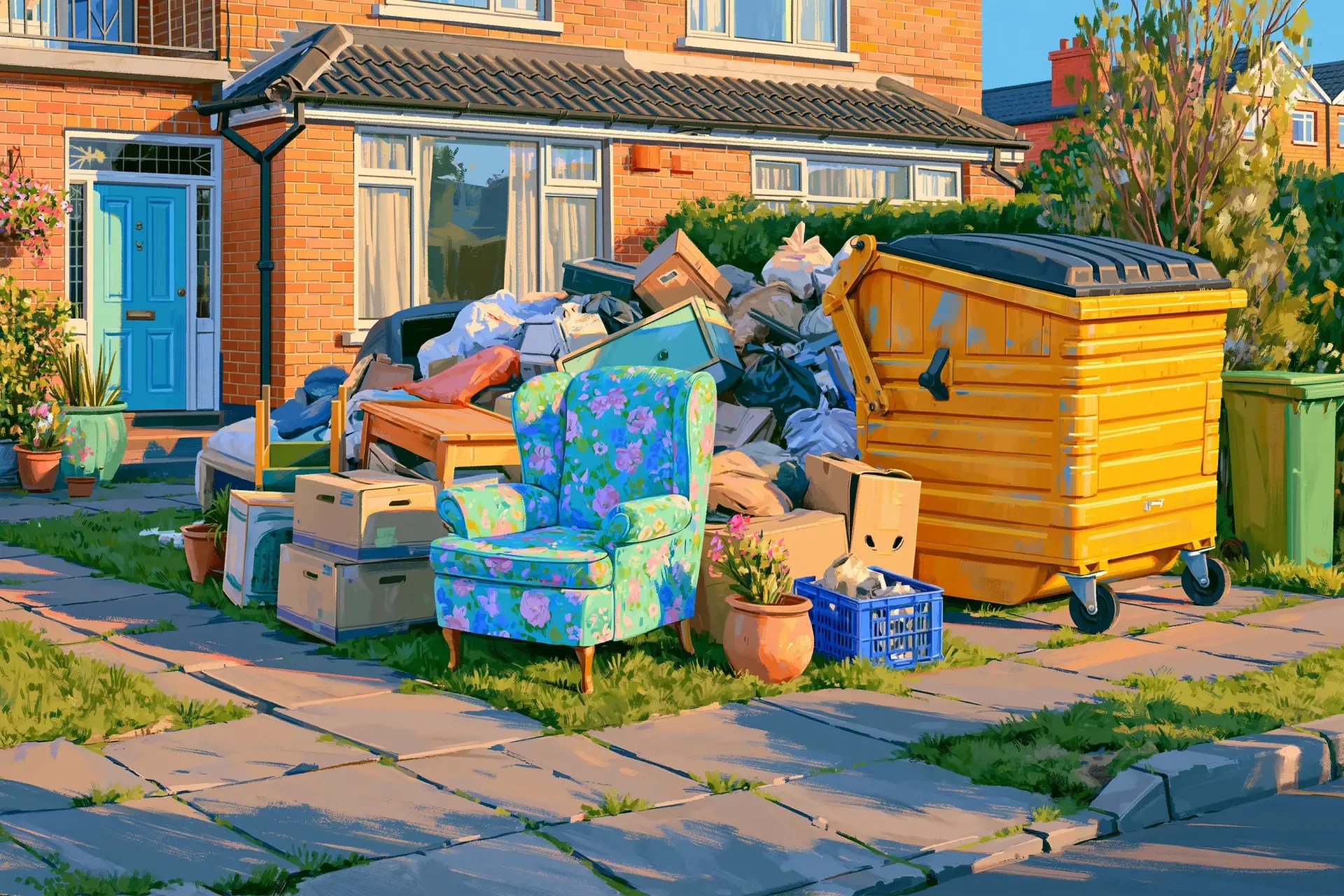
Site clearance, junk removal and skip hire are eligible Category 1 works — but only when quoted and approved before the work starts.
One rule governs all of it, and it is the difference between a successful claim and a refused one: the full application, including itemised clearance quotes, must be approved by the local authority before any physical work begins on site. You cannot claim retrospectively for clearance, junk removal or skip hire that happened before you received the formal approval letter, and a standalone clearance with no wider approved renovation plan behind it will also be refused.
Approval Before You Lift a Finger:
Get the approval letter or approval in principle first. Clearance done before that letter — however eligible the work itself — cannot be reimbursed. Build your clearance quote into the application from the start.
Owners preparing a vacant or derelict property can use Kollect to handle junk removal, skip hire, garden clearance and asbestos removal anywhere in Ireland, with all of these services eligible under the grant and itemised quotes available immediately to drop straight into the application pack.
5. What Else Does the Grant Cover?
Once the site is cleared, the Croí Cónaithe scheme funds a broad range of refurbishment works designed to restore structural integrity, modernise services and finish the home to a habitable standard. Local authorities assess these costs against standard pricing guidelines modelled on a two-storey, three-bedroom semi-detached house, so the allowances are benchmarked rather than open-ended.
The eligible works span four practical areas. Substructure covers foundation repairs, floor slab installation and underpinning. Superstructure deals with internal and external walls, chimneys and roof structures. Services cover modern plumbing, heating, power distribution and ventilation. On top of the physical build, professional services such as architectural surveys, engineering assessments and quantity surveying are also fundable, capped at ten per cent of the net construction cost or €14,000, whichever is lower.
| Works Category | What It Includes |
|---|---|
| Site clearance & hazardous waste (Category 1) | Junk removal, skip hire, garden clearance, full house clearance, asbestos and hazardous material removal. |
| Substructure | Foundation repairs, floor slab installation, underpinning. |
| Superstructure | Internal and external walls, chimneys, roof structures. |
| Services | Plumbing, heating, power distribution, ventilation. |
| Professional fees | Architectural surveys, engineering assessments, quantity surveying — capped at 10% of net cost or €14,000. |
6. What Does the Grant Not Cover?
The scheme is generous, but it draws firm lines around what it will and will not fund, and knowing them early saves a wasted application. The single biggest exclusion is a full demolition and rebuild: if you knock the property down to build a brand-new house on the footprint, the project is disqualified. The original structural envelope has to be preserved and refurbished rather than replaced.
Outside the Grant's Scope:
- Demolish-and-rebuild — flattening the structure to build new on the footprint is disqualified.
- SEAI-eligible energy works — anything fundable by the SEAI is excluded here and must be claimed through SEAI instead.
- Standalone fossil-fuel boilers — ineligible since 1 December 2024, in line with the EU Energy Performance of Buildings Directive.
- Corporate applicants — developers, builders and registered companies cannot access the fund.
Energy-efficiency works that the Sustainable Energy Authority of Ireland already funds are carved out of this grant, so they must be financed separately through the SEAI rather than double-claimed. Standalone fossil-fuel boiler installations have been ineligible since 1 December 2024, ensuring the scheme complies with the EU Energy Performance of Buildings Directive. And, as with eligibility generally, the fund is closed to corporate entities, developers and commercial builders — it exists to help private individuals and households secure long-term housing.
7. Can I Combine This Grant With an SEAI Grant?
Yes, and doing so is one of the smartest moves available to anyone restoring a tired property. The two schemes are designed to sit side by side: the local authority grant handles structural remediation and site clearance, while the Sustainable Energy Authority of Ireland funds the energy performance side. The only boundary is that you cannot claim the same energy work twice, which is exactly why SEAI-eligible works are excluded from the refurbishment grant.
The SEAI Better Energy Homes scheme and the National Home Energy Upgrade Scheme provide fixed grants for fabric upgrades such as attic insulation, cavity wall insulation, dry lining and external wall insulation, plus high-performance windows and doors, solar water heating and solar electricity. To move a home off fossil fuels, the SEAI heat pump package can provide up to €12,500, bundling the heat pump unit with radiator upgrades and a renewable heat bonus for removing an old oil or gas boiler. You can manage the works yourself with registered contractors or use an authorised One Stop Shop that deducts the grant value from your upfront bill.
| SEAI Support | What It Funds |
|---|---|
| Better Energy Homes / National Home Energy Upgrade | Attic, cavity wall and external wall insulation, dry lining, windows and doors, solar water and electricity. |
| Heat Pump System Grant | Up to €12,500, including radiator upgrades and a renewable heat bonus. |
| Home Energy Upgrade Loan Scheme | €5,000–€75,000, unsecured, up to a 10-year term; up to 25% usable for non-energy improvements. |
Finance is available too. The Home Energy Upgrade Loan Scheme, backed by the Strategic Banking Corporation of Ireland and the European Investment Bank, lets homeowners borrow between €5,000 and €75,000 over up to ten years for SEAI grant-aided works. The loan is unsecured, and up to a quarter of it can go toward non-energy improvements such as redecorating — useful where site clearance and energy retrofitting are happening in the same project.
8. How Do I Apply?
Applications run through the local authority, and the sequence is strict because the payment is retrospective. Getting the order right is what protects your clearance and renovation costs from being refused.
The Application, Step by Step:
- 1. Gather your documents — proof of ownership (title deeds or solicitor letter) and proof of at least two years' vacancy.
- 2. Get itemised quotes — detailed estimates from fully tax-compliant contractors for clearance and renovation.
- 3. Commission a structural report — if derelict, from a chartered engineer or registered architect.
- 4. Submit the pack — to the housing section of your local authority, addressed to the Vacant Homes Officer.
- 5. Site inspection — a council inspector verifies vacancy, structural state and eligibility of the works.
- 6. Wait for approval — do not start on site until the formal approval letter or approval in principle arrives.
- 7. Complete the works — typically within thirteen months, then submit all invoices.
- 8. Final inspection & payment — the council checks the works against approved costs and processes the reimbursement.
For applicants who struggle to get a conventional mortgage on a dilapidated property, the Local Authority Purchase and Renovation Loan can bridge the gap. It builds in a bridging loan matched to the approved grant value, and because that bridging element is repaid automatically once the council pays out the refurbishment grant, it expands borrowing capacity and makes otherwise unviable projects work. For official forms and local guidance, contact the Vacant Homes Officer in your council — these officers sit across every local authority, from Clare to Wexford to Westmeath, and are the primary guide through the scheme.

From empty shell to liveable home — keeping every clearance and works invoice is what secures the retrospective payout.
9. How Kollect Can Help
Preparing a vacant or derelict property for habitation is an intensive job, and the clearance and hazardous-waste stages in particular need certified expertise to stay safe and compliant. Kollect handles that entire opening scope — professional junk removal, skip hire, garden clearance and certified asbestos removal — across all twenty-six counties of Ireland.
As a fully licensed and insured operator, Kollect manages all waste in line with national environmental regulations, which matters directly to your grant claim: local authorities require fully itemised contractor quotes and tax clearance evidence before they approve funding. Kollect supplies the compliant invoices and documentation a smooth retrospective claim depends on, so the significant preparation costs of a clearance can actually be recovered. Working with a single national provider also lets you lock in accurate quotes for the council submission and be confident that hazardous materials such as asbestos are removed safely and legally.
Conclusion
The Vacant Property Refurbishment Grant is far more than a structural-works subsidy. Site clearance, junk removal, skip hire, garden clearance and asbestos removal are all eligible expenses under Category 1, which means the messy, expensive first phase of bringing an empty home back to life can be reimbursed — provided you do it in the right order. Build itemised clearance quotes into the application, wait for the approval letter before anyone sets foot on site, keep every invoice, and the costs come back to you. With up to €70,000 on the table for a derelict home, and the option to stack SEAI energy grants on top, the economics of restoring a vacant property have rarely been stronger. To get a compliant, itemised clearance quote for your application, book online in minutes or call 01 697 2259.
Clearing a vacant or derelict property?
Kollect handles junk removal, skip hire, garden clearance and certified asbestos removal nationwide — with the itemised, compliant invoices your grant application needs.